Types of Queues: Simple, Circular, and Priority Queues | Data Structures and Algorithms Day #9
Explore the different types of queues: simple, circular, and priority
Software Engineer & Technical Writer
Understanding the different types of queues is crucial for mastering data structures. Queues operate based on the FIFO (First-In-First-Out) principle, making them essential in situations where elements need to be processed sequentially, such as task scheduling, handling requests, or managing buffers. In this article, we’ll explore the simple queue, circular queue, and priority queue, discuss their operations, and look at Python and JavaScript code examples for each type.
What is a Simple Queue?
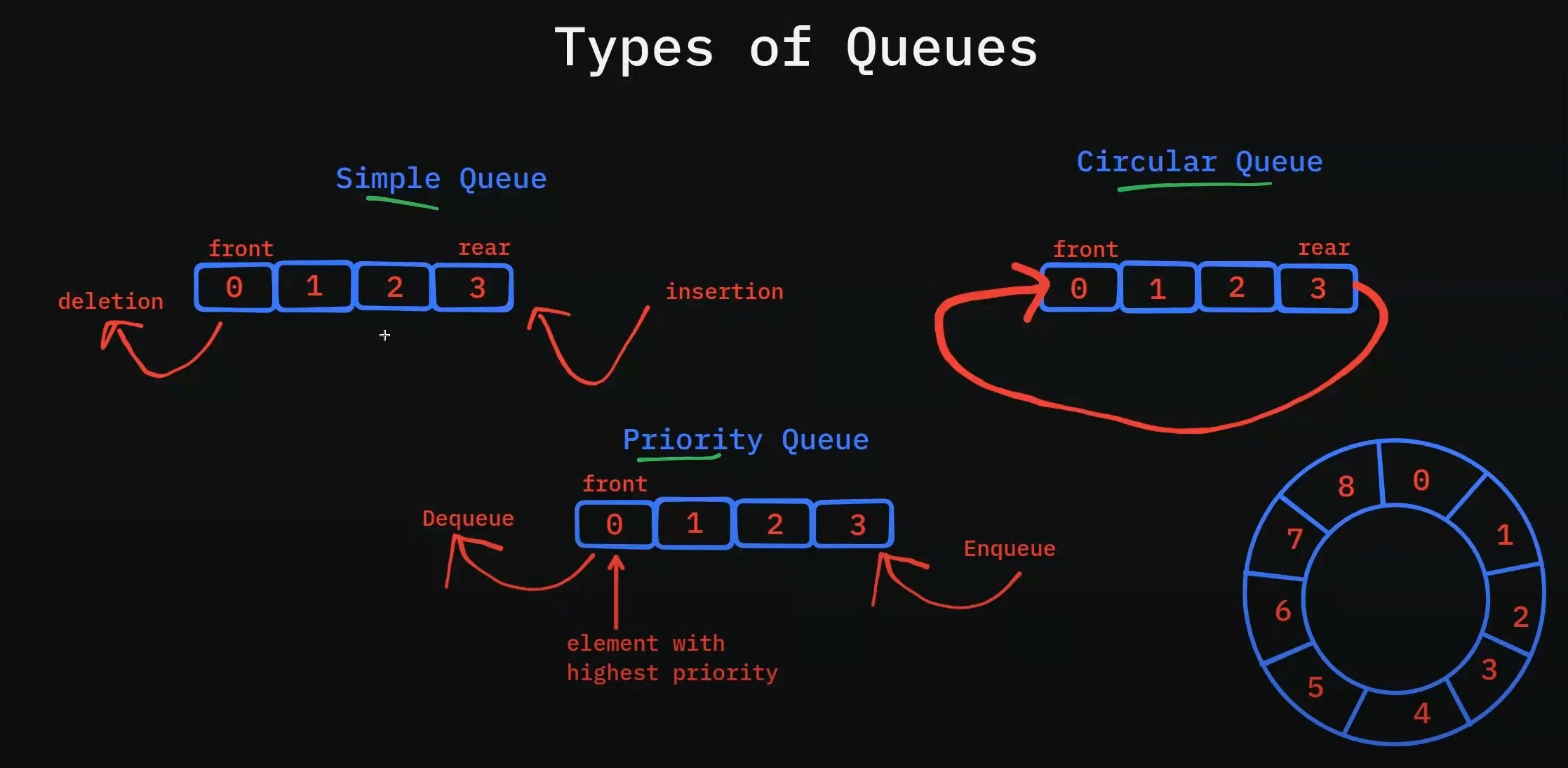
A simple queue, also called a linear queue, is the most basic type of queue. It follows the FIFO principle, meaning the first element added is the first to be removed.
Operations on Simple Queue
Enqueue – Add an element to the rear of the queue.
Dequeue – Remove an element from the front.
Peek – View the front element without removing it.
isEmpty – Check if the queue is empty.
Python Code Example for Simple Queue
class SimpleQueue:
    def __init__(self):
        self.queue = []

    def enqueue(self, item):
        self.queue.append(item)

    def dequeue(self):
        if not self.is_empty():
            return self.queue.pop(0)
        return "Queue is empty!"

    def peek(self):
        return self.queue[0] if not self.is_empty() else None

    def is_empty(self):
        return len(self.queue) == 0

# Example Usage
q = SimpleQueue()
q.enqueue(1)
q.enqueue(2)
print(q.dequeue())  # Output: 1
JavaScript Code Example for Simple Queue
class SimpleQueue {
  constructor() {
    this.queue = [];
  }

  enqueue(item) {
    this.queue.push(item);
  }

  dequeue() {
    return this.queue.length ? this.queue.shift() : "Queue is empty!";
  }

  peek() {
    return this.queue[0] || null;
  }

  isEmpty() {
    return this.queue.length === 0;
  }
}

// Example Usage
const q = new SimpleQueue();
q.enqueue(1);
q.enqueue(2);
console.log(q.dequeue()); // Output: 1
Circular Queue
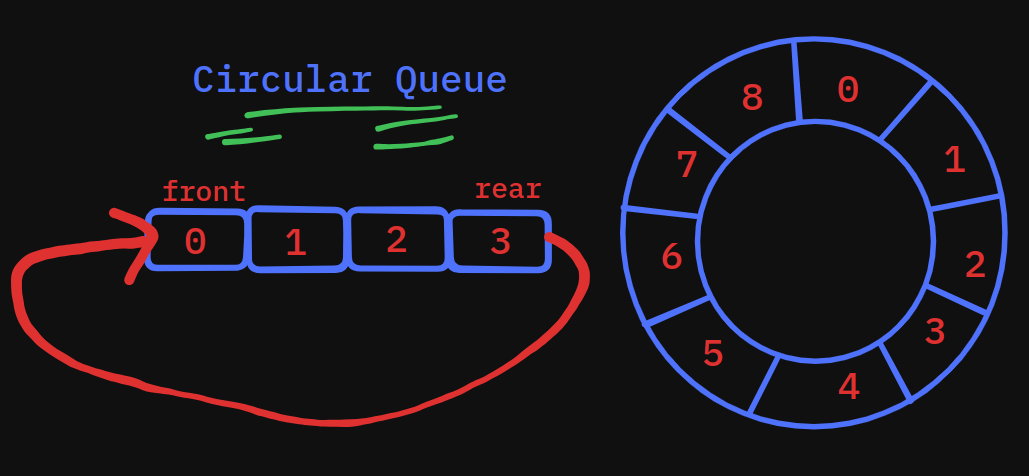
A circular queue connects the rear and front of the queue to create a loop, allowing efficient use of space. When the end of the queue is reached, new elements can be added at the beginning if there is space available.
Python Code Example for Circular Queue
class CircularQueue:
    def __init__(self, size):
        self.queue = [None] * size
        self.size = size
        self.front = self.rear = -1

    def enqueue(self, item):
        if (self.rear + 1) % self.size == self.front:
            return "Queue is full!"
        elif self.front == -1:
            self.front = self.rear = 0
        else:
            self.rear = (self.rear + 1) % self.size
        self.queue[self.rear] = item

    def dequeue(self):
        if self.front == -1:
            return "Queue is empty!"
        item = self.queue[self.front]
        if self.front == self.rear:
            self.front = self.rear = -1  # Queue is now empty
        else:
            self.front = (self.front + 1) % self.size
        return item
Priority Queue: When Order Matters
A priority queue allows elements to be dequeued based on their priority rather than their arrival order. This is useful in scenarios like scheduling or pathfinding algorithms.
JavaScript Code Example for Priority Queue
class PriorityQueue {
  constructor() {
    this.queue = [];
  }

  enqueue(item, priority) {
    const newItem = { item, priority };
    let added = false;

    for (let i = 0; i < this.queue.length; i++) {
      if (this.queue[i].priority > priority) {
        this.queue.splice(i, 0, newItem);
        added = true;
        break;
      }
    }

    if (!added) this.queue.push(newItem);
  }

  dequeue() {
    return this.queue.length ? this.queue.shift() : "Queue is empty!";
  }
}
Comparison of Queue Types
| Queue Type | Structure | Use Case |
| Simple Queue | Linear | General-purpose FIFO processing |
| Circular Queue | Circular, with wrapped ends | Efficient memory usage |
| Priority Queue | Based on priority, not FIFO | Task scheduling, pathfinding |
Time Complexities of Queue Operations
| Operation | Simple Queue | Circular Queue | Priority Queue |
| Enqueue | O(1) | O(1) | O(n) |
| Dequeue | O(1) | O(1) | O(1) |
| Peek | O(1) | O(1) | O(1) |
Real-World Applications
Simple Queue: Printer job scheduling, task management.
Circular Queue: Memory management in embedded systems.
Priority Queue: Task scheduling in operating systems and Dijkstra’s algorithm.
FAQs
What is the difference between a circular and simple queue?
A circular queue wraps around when the end is reached, utilizing empty spaces more efficiently.
How does a priority queue work?
A priority queue processes elements based on their priority rather than the order of insertion.
What are some real-world uses of priority queues?
They are used in task scheduling, network routing, and shortest path algorithms.
Conclusion
Try implementing these queue types in Python or JavaScript using the code examples provided, and explore their applications further in your projects.